Solutions

The elevator stops at 22:00. Someone has to pick up.

Fault reports don't keep office hours. SayTrue records every report with the details your technicians need, applies your urgency rules, and never loses a call in voicemail.

Fault intake AI

Every report taken, structured, timestamped

Building, apartment, what's broken, since when, access notes — captured as a ticket your team works through, not a garbled message.

Urgency triage

Water pouring gets your emergency path

Your urgency categories decide: emergencies get your on-call arrangement stated exactly; the rest queues for business hours, honestly.

Status questions

‘When will it be fixed’ without a phone chain

Where you expose work-order status read-only, the agent answers; where you don't, it records the follow-up and says when the office answers.

Resident FAQ

The handbook questions, off your inbox

Trash schedules, meter readings, common-area rules, contact points — answered from approved entries at any hour, in the resident's language.

The story

A burst pipe no longer arrived as an unlabelled voicemail.

A property manager's shared number handled maintenance questions, meter readings and urgent damage reports. After hours, a tenant might leave only a first name and 'water everywhere', while the on-call person needed the building, unit and immediate risk.

The manager defined fault categories and the details required for each. SayTrue answers building procedures, records structured reports, and transfers only the categories and hours the manager marks as urgent. Every handover includes the caller's wording rather than a reconstructed note.

The on-call person can now see the property, unit, damage, access instructions and contact before deciding what to do. Routine requests wait in a complete queue, while the manager reviews unanswered questions to improve building-specific entries instead of teaching the same exception over the phone again.
How the property manager sets it up

  1. Map buildings and house rulesContacts, access instructions, waste, parking and shared-system facts become property-specific entries.
  2. Define fault categoriesWater, heating, lift, electricity and routine repairs each ask for the details the contractor needs.
  3. Set the emergency routeOnly configured categories transfer to on-call contacts, and only during the hours they cover.
  4. Test an incomplete reportCall without a unit number and confirm the agent asks for it before creating the ticket.

A useful fault entry combines the tenant-facing instruction with the routing rule.

Question The agent answers Autonomy
Where do I report a meter reading? States the approved channel and the identifiers the manager requires. answers alone
The hallway light has failed. Captures building, location and contact as a routine maintenance ticket. opens a ticket
Water is entering my apartment. Collects building, unit and immediate risk, then follows the urgent handover route. hands to a human
The lift is stopped. States the approved safety instruction and routes according to the lift-fault category. hands to a human
When is bulky waste collected? Reads the current building-specific collection entry. answers alone
EXAMPLE KB Demo data (Code Alpha) · Illustrative scenario
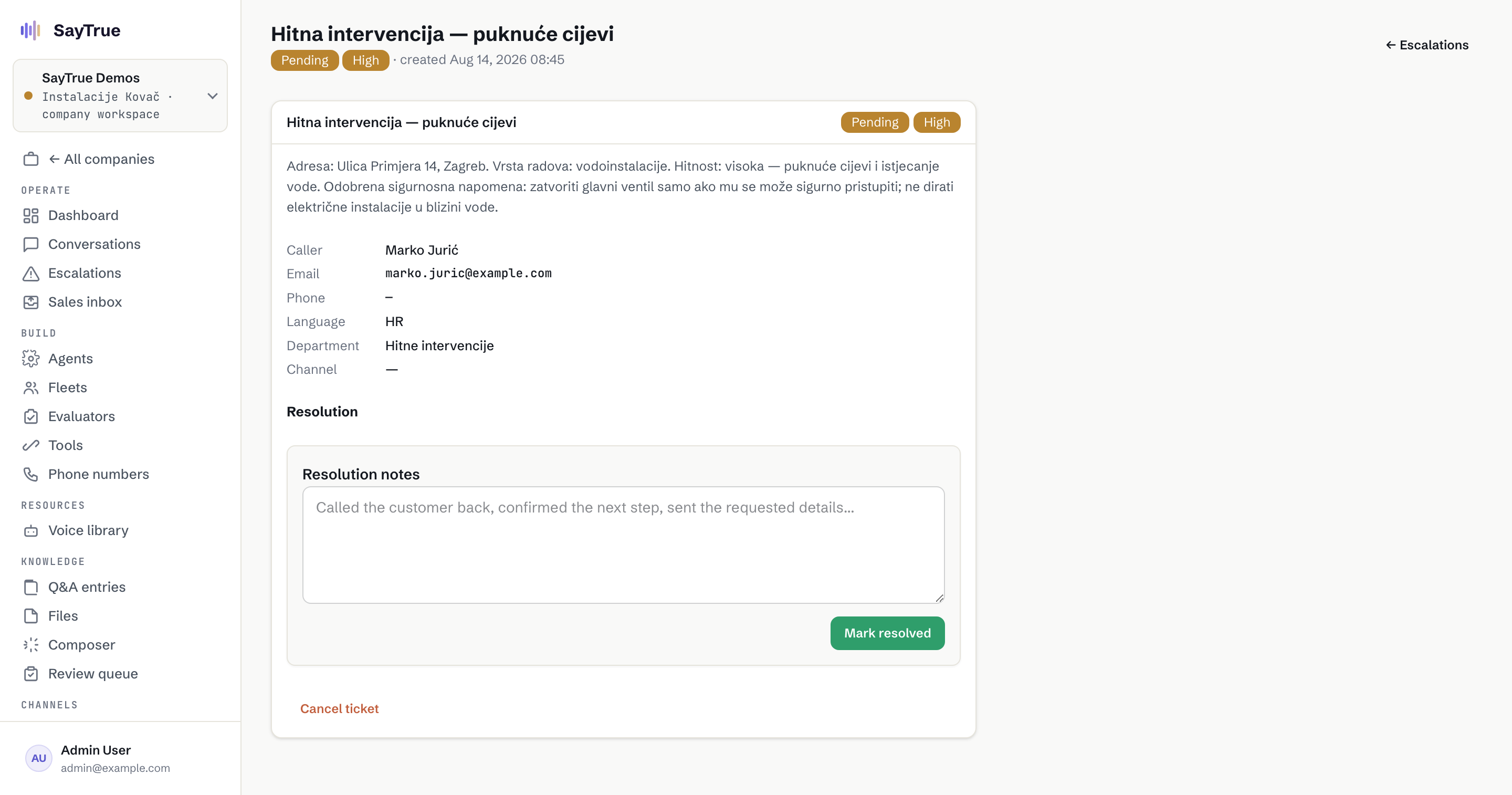
An Instalacije Kovač fault ticket in the SayTrue console showing Ulica Primjera 14, plumbing work, high priority, the approved safety note and the Hitne intervencije department
SCREEN 01 Address, plumbing fault, high priority and the approved safety note reach Emergency Interventions together. Demo data (SayTrue Demos) · Illustrative scenario
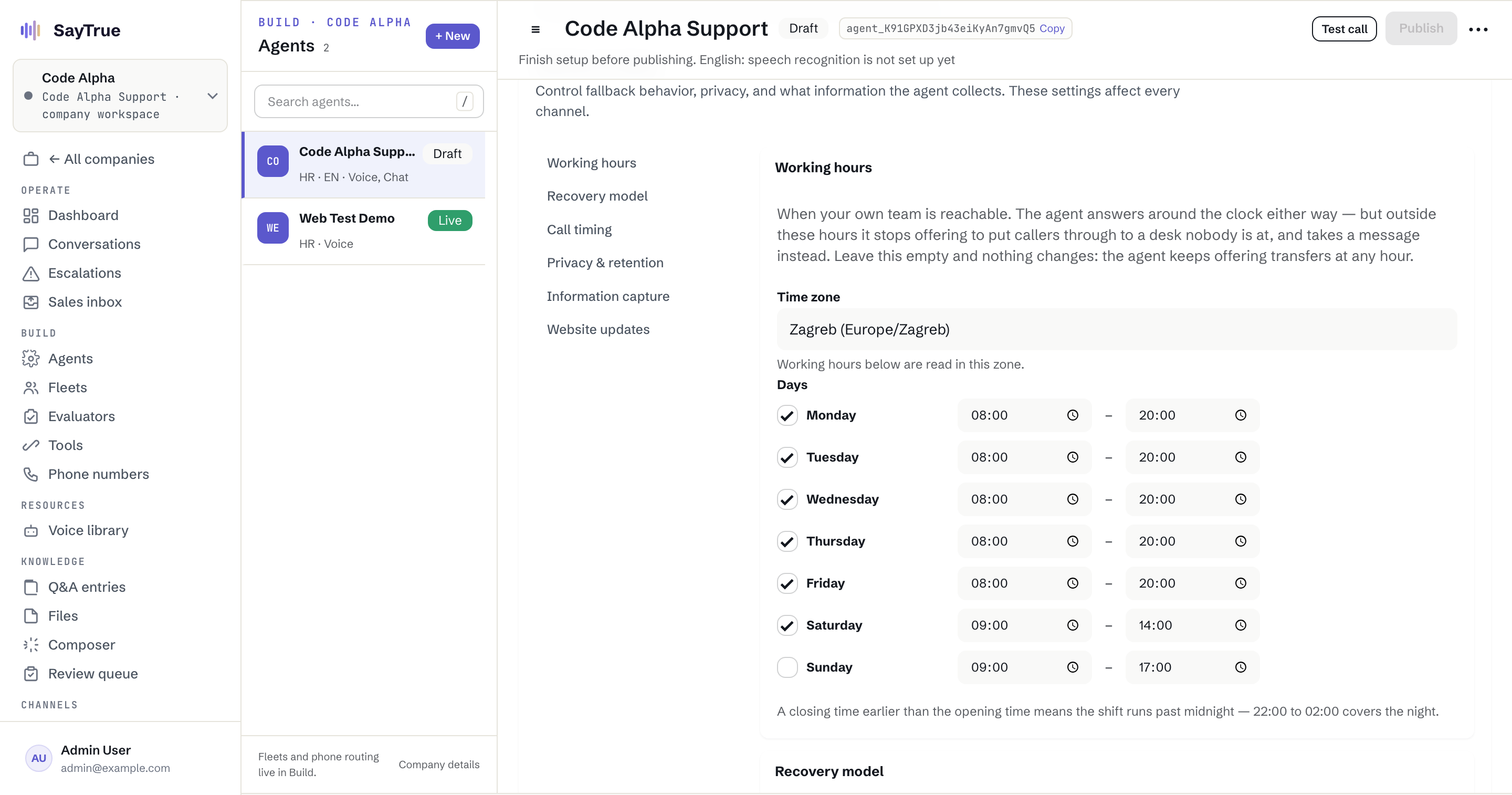
On-call hours for property-management emergencies
SCREEN 02 Urgent routing follows the actual on-call schedule. Demo data (Code Alpha) · Illustrative scenario

See this on your own phone line and website.

Book a demo

What buyers in this trade ask us

How does the agent know what counts as an emergency?

You define the categories — water, gas, elevator with people inside — and the agent applies them by matching the report against your classifications, then states your emergency arrangement verbatim. Everything ambiguous defaults to the more cautious path you chose.

Where do the fault tickets go?

To your console and the addresses you configure, structured: building, unit, reporter contact, description, urgency class, timestamp. Your dispatcher starts with data, and the source log shows exactly what was said.

Can residents check repair status?

If your work-order system exposes status read-only, yes — live, with the lookup logged. Otherwise the agent records the inquiry and states office hours honestly rather than promising updates nobody scheduled.

We manage 40 buildings — does that scale?

Buildings are data, not code: per-building details live as structured entries, and the resident's address routes the answer. Adding building 41 is an afternoon of entries, not a project.

More depth in our guides →

Answers your customers can trust.

Grounded in your knowledge, honest about its limits, and handed to your team the moment it should be.