Solutions

The most repeated question in commerce: where is it?

Web shops, repair shops, services — the agent looks the status up in your system read-only and answers live, with every lookup logged in the transcript.

Live lookup

Status by number, answered in seconds

Order or work-order number in, current status out — through a read-only connector to your system, logged in the transcript.

Read-only by design

It can look; it can never touch

No cancellations, no changes, no refunds — the connector layer physically permits GET lookups and nothing else.

Honest fallback

No connector? No guessing

Where live data isn't exposed, the agent records a callback request and says when your team answers — a true 'I don't know' beats a false 'tomorrow'.

Fewer interruptions

Your specialists stay on the work

Every absorbed status call is a mechanic not walking to the lift, a packer not opening the CRM — the compounding win of the boring question.

The story

A live status replaced the copied tracking reply.

A commerce team spent each day opening an order system, finding a reference and copying the same status into phone and chat replies. When the system was slow or the order needed a change, callers received inconsistent promises depending on who answered.

SayTrue performs the approved read-only lookup and tells the customer exactly what the source returns. A failed lookup becomes an honest request for support, and any address change, cancellation or exception goes to a person because the agent cannot write to the order.

Customers get a useful answer when the system has one and a clear handover when it does not. Operations keeps every write action, while the transcript preserves the lookup and result. That makes a stale status or connector failure reviewable instead of turning it into an unsupported promise.
How to expose order status safely

  1. Choose the visible statesDefine which status fields may be read back and how each should be explained.
  2. Connect one read-only lookupThe lookup accepts the required reference, has a response cap and remains logged.
  3. Route order changesAddress, cancellation and return exceptions create tickets or transfer to support.
  4. Test the unavailable sourceConfirm a timeout produces an honest fallback instead of a stale or invented status.

Status wording and exception handling surround the live lookup.

Question The agent answers Autonomy
Where is my order? Reads the current permitted status returned for that reference. answers alone
What does dispatched mean? Explains the approved status definition and next expected event. answers alone
The lookup cannot find my order. Collects reference and contact for support instead of inventing a state. opens a ticket
Change the delivery address. Does not alter the order and routes the request to support. hands to a human
The parcel is marked delivered but is missing. Captures the exception and follows the configured claims route. hands to a human
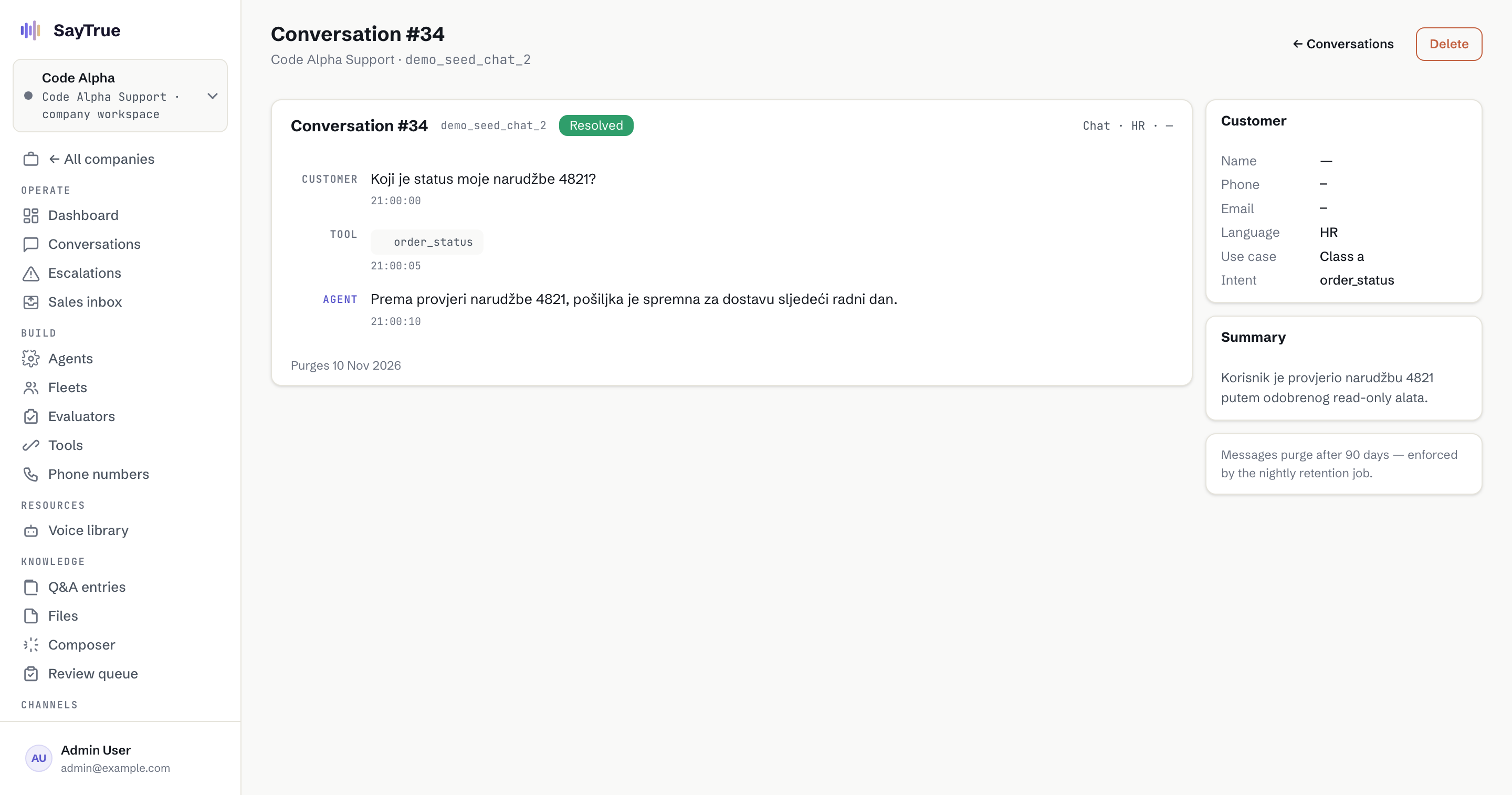
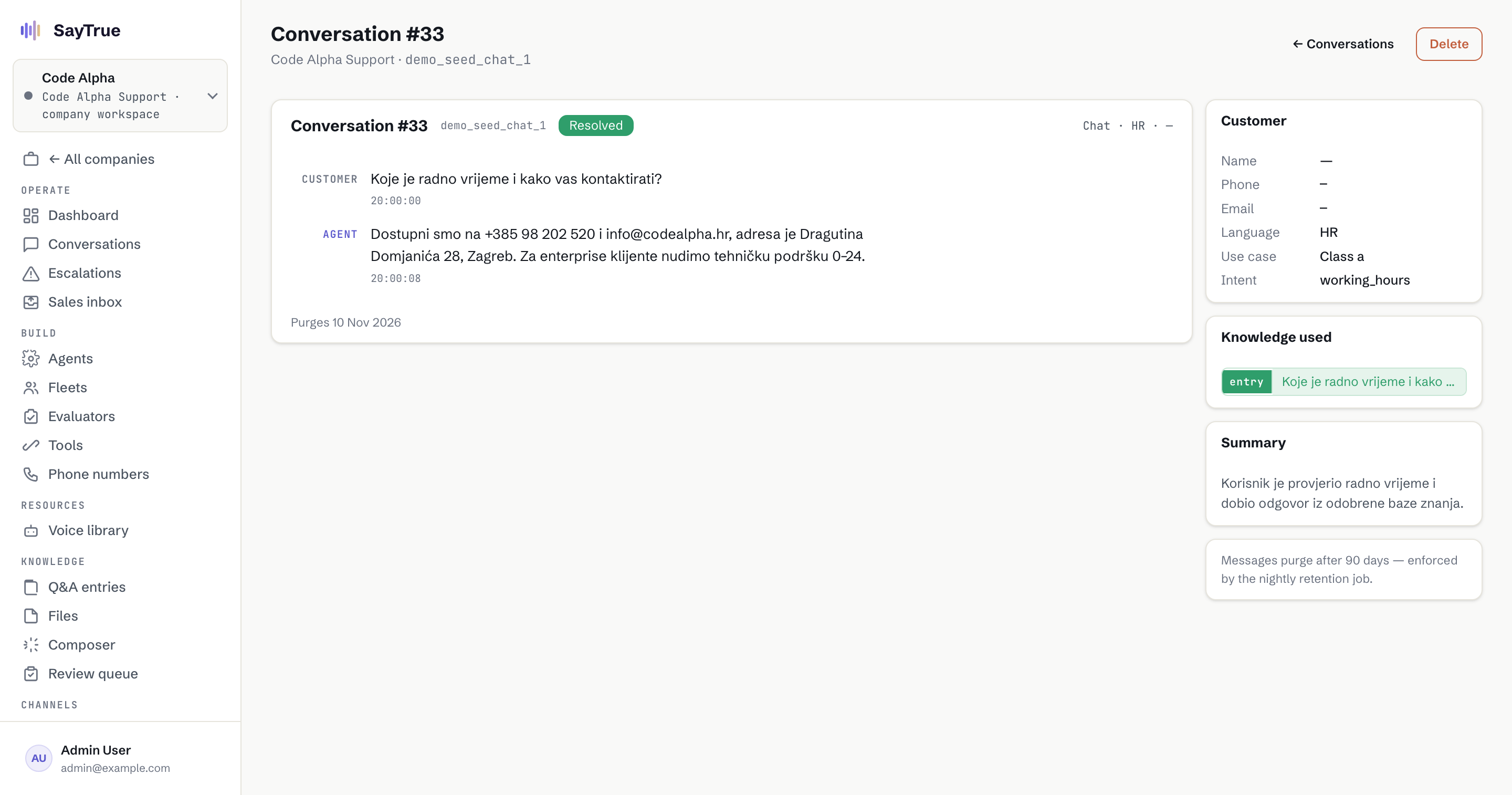
EXAMPLE KB Demo data (Code Alpha) · Illustrative scenario
A read-only order-status call recorded in SayTrue
SCREEN 01 The conversation shows which lookup supplied the status. Demo data (Code Alpha) · Illustrative scenario
An order-status conversation with an honest exception handoff
SCREEN 02 A failed or disputed status becomes a support request with context. Demo data (Code Alpha) · Illustrative scenario

See this on your own phone line and website.

Book a demo

What buyers in this trade ask us

What exactly can the agent see in our system?

Exactly the fields your system exposes to the lookup, shaped during setup so it reads what it needs and nothing more. Each lookup is enabled by a human, credentials are encrypted and injected only at request time, and every call lands in the transcript.

What if our system is down or slow?

The agent says the lookup didn't succeed and offers the fallback — recorded callback or transfer — instead of stalling the caller. Failures are visible in the transcript, not swallowed.

Is an order number enough to protect privacy?

You decide the verification bar: the connector can require whatever identifiers your system needs — order number plus email, for instance — and the agent asks for exactly those before looking up.

More depth in our guides →

Answers your customers can trust.

Grounded in your knowledge, honest about its limits, and handed to your team the moment it should be.