Solutions

Twenty questions make up most of your phone traffic.

Hours, prices, rules, directions — answered instantly and identically on every channel, from entries you approved, with every miss logged as a gap to close.

Instant answers

The routine calls, absorbed on arrival

The questions your staff answer daily become entries answered in seconds — on phone, chat, Messenger and Instagram at once.

One truth

The same answer every time, every channel

No more depending on who picks up: the approved entry is the answer, and one edit updates everything.

Gap logging

Every miss becomes a to-do

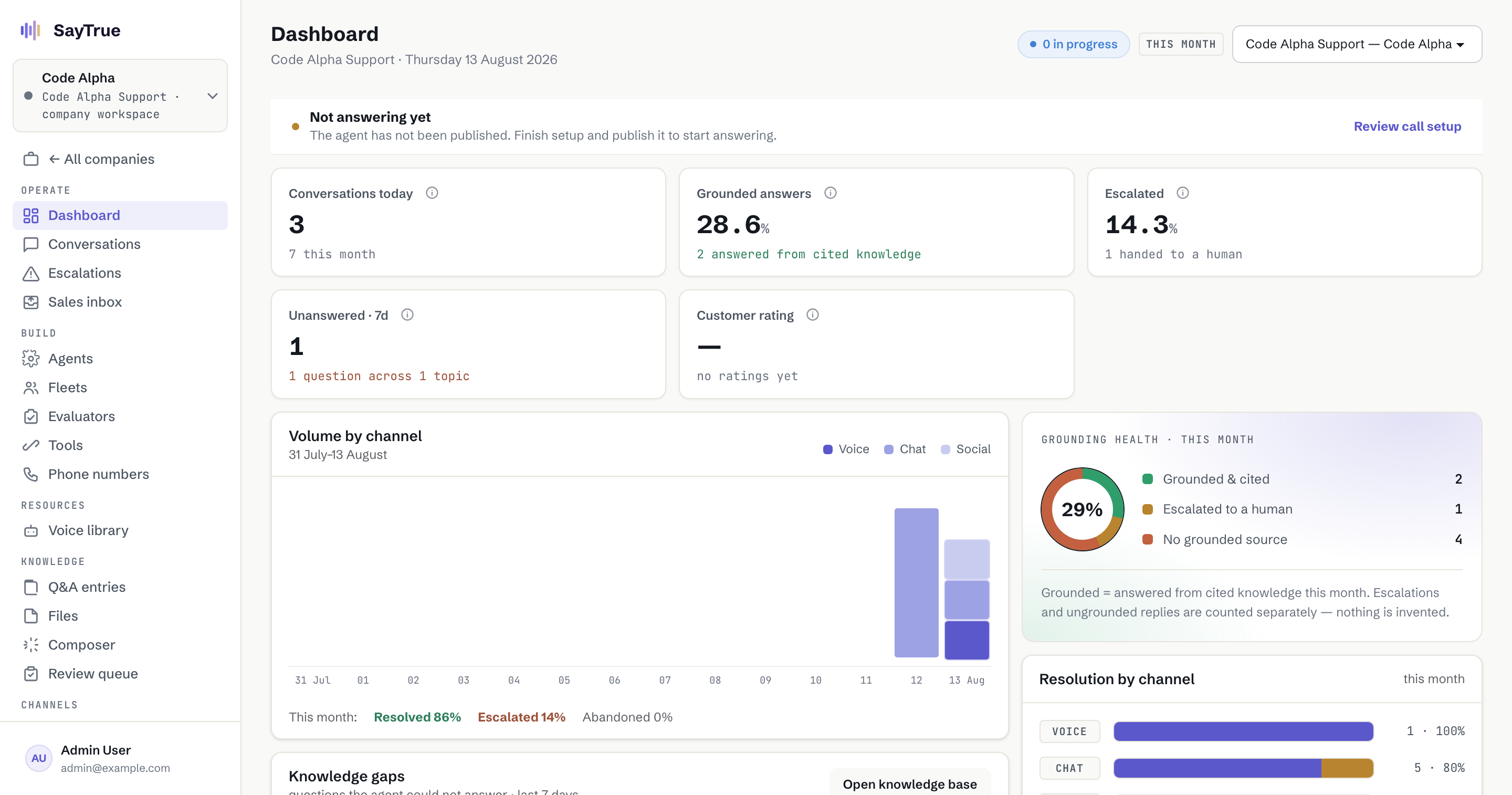
Questions without grounded answers are logged with frequency — your knowledge base grows exactly where demand is.

Staff relief

Humans for the human questions

When the routine is absorbed, your people handle the exceptions, the emotions and the sales — the calls that actually need them.

The story

The repeated question became an entry once, not an answer every time.

A small support team knew most calls by the opening sentence: hours, documents, prices, preparation, delivery or how a policy worked. The answers were familiar but varied slightly by person, and the genuinely unusual requests waited behind them.

The team approved a concise entry for each repeated question. SayTrue answers from that set across phone, chat and social channels, logs the source used, and records the questions it could not answer. Those gaps become the next editing queue rather than an invitation to improvise.

The support lead can inspect which entry supported a reply and which phrase still failed to find one. Editing remains a small operational loop: approve the fact, test the hardest wording, publish it, and watch whether the same question disappears from the gap list.
How to deflect FAQs without losing control

  1. Start from real conversationsCollect the questions staff repeat and write the answer exactly as customers should hear it.
  2. Assign an autonomy classRoutine facts answer alone; requests open tickets; judgment calls reach a person.
  3. Publish to every channelOne approved entry becomes available to voice, web chat and connected social inboxes.
  4. Review knowledge gapsUnanswered questions enter the gap report so the team improves coverage deliberately.

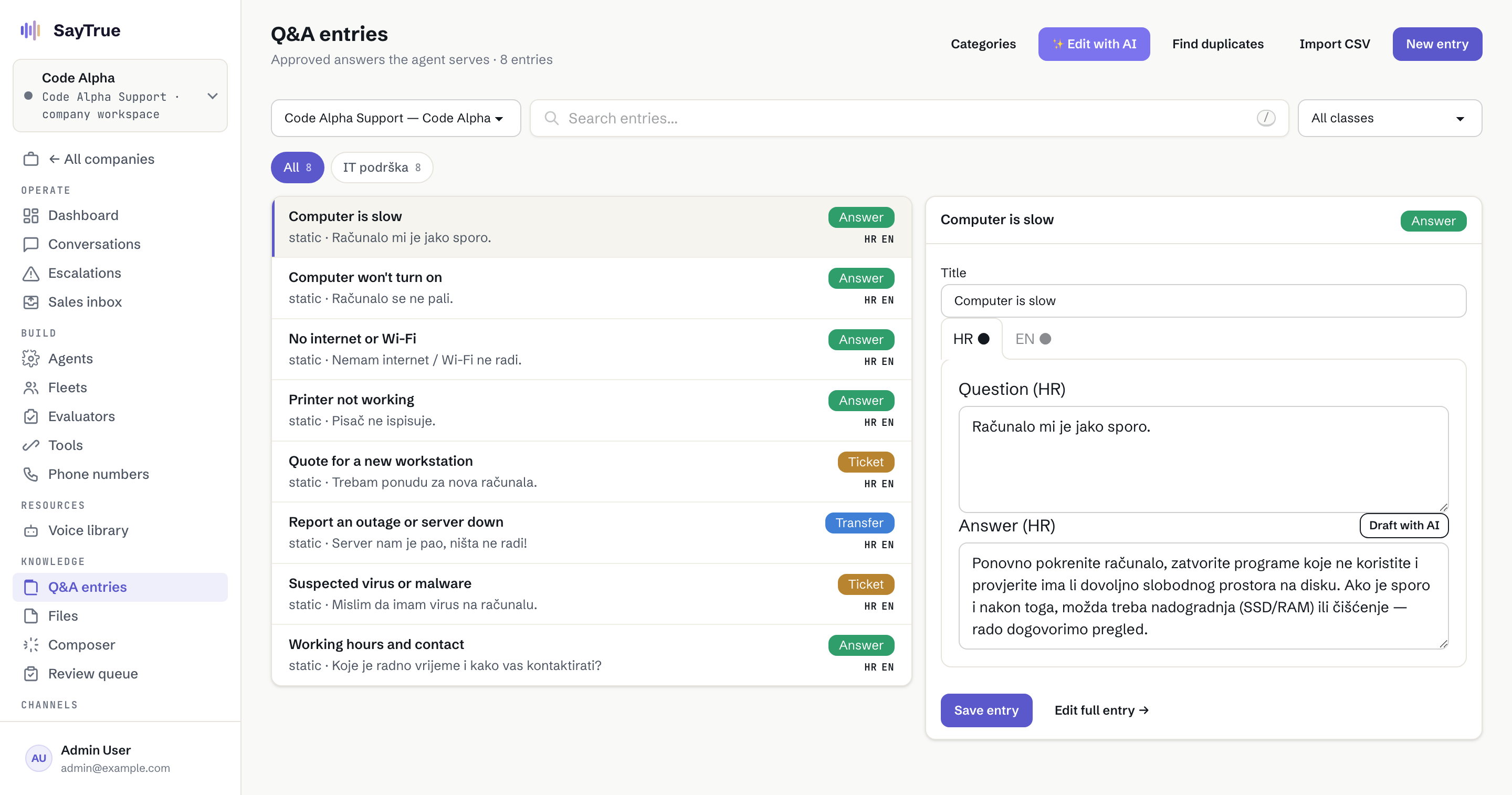
A short entry works because its autonomy boundary is explicit.

Question The agent answers Autonomy
What are your opening hours? Reads the current hours entry for the relevant location. answers alone
Which documents should I bring? Lists the approved documents for the named service. answers alone
I need a written quote. Collects scope and contact for the sales team. opens a ticket
Make an exception to your policy. States the policy and sends the exception request to a person. hands to a human
Your answer does not cover my case. Records the missing context as a knowledge gap and offers the configured handover. hands to a human
EXAMPLE KB Demo data (Code Alpha) · Illustrative scenario
Approved FAQ entries and autonomy classes in SayTrue
SCREEN 01 The team owns both the answer and when it may be used. Demo data (Code Alpha) · Illustrative scenario
SayTrue dashboard showing knowledge gaps for review
SCREEN 02 Questions without an approved answer become visible work. Demo data (Code Alpha) · Illustrative scenario

See this on your own phone line and website.

Book a demo

What buyers in this trade ask us

How do we know what to put in the knowledge base first?

Start with what your staff already repeat — the builder drafts from your website, and after launch the gap report ranks missing answers by real frequency. You write what callers actually ask, not what a workshop guessed.

What happens to questions outside the base?

An honest refusal with a next step: handover during hours, a recorded request outside them — and a gap log entry either way. The agent never fills silence with plausible invention; that rule is the product.

Won't customers hate not reaching a human?

Asking for a human is always honored — it's a built-in trigger. Deflection is for the caller who wants the opening hours in ten seconds, not the one who wants a conversation; both get what they came for.

More depth in our guides →

Answers your customers can trust.

Grounded in your knowledge, honest about its limits, and handed to your team the moment it should be.