Solutions

Turn ‘which one fits?’ into a grounded product path.

The visitor describes the model and need. SayTrue finds documented compatibility, links the product, and asks the team when the catalogue cannot prove the match.

Guided discovery

Ask for the facts that actually narrow the catalogue

Model, variant and intended use become a short conversation instead of a wall of filters.

Documented fit

Recommend only what the catalogue can support

Structured fitment entries or a read-only lookup supply the match and the relevant product link.

Honest uncertainty

An unclear fit becomes a lead, not a confident mistake

The visitor's vehicle and need reach the team when compatibility cannot be confirmed.

Policy answers

Stock, warranty and returns stay beside the recommendation

Approved policy entries and permitted lookups answer the practical questions that block a purchase.

The story

The web shop turned compatibility questions into a buying path.

An automotive web shop sold products that looked similar but depended on the exact car variant. Visitors typed a model into chat, received a link to a category, and left when they still could not tell which item fitted. Support answered the same fitment questions by searching the catalogue manually.

The shop structured the compatibility facts it was prepared to stand behind. SayTrue asks for the vehicle and need, reads those facts or a permitted catalogue lookup, and links the matching product page. When the evidence is incomplete, the agent says that plainly and creates a lead for a specialist instead of inventing compatibility.

Merchandisers decide which fitment facts are safe to expose and support owns every uncertain case. The transcript shows the vehicle details, lookup and recommendation, while repeated misses reveal where the catalogue needs a clearer compatibility entry before the next visitor asks the same question.
How the web shop sets up product finding

  1. Structure the fitment knowledgeOne entry per product family names the models, variants, exclusions and caveats that determine fit.
  2. Add an optional catalogue lookupA read-only lookup may return fit and availability; it cannot change products, stock or orders.
  3. Place chat beside the catalogueOne widget script gives visitors a guided question path and links back to product pages.
  4. Route uncertain matchesVehicle, variant, need and contact become a specialist lead when the source cannot confirm fit.
  5. Test the hardest combinationsUse known matches, exclusions and an undocumented variant before publishing.

Fitment facts carry product links and explicit exclusions; uncertainty has its own route.

Question The agent answers Autonomy
Which module fits my Golf diesel? Asks for the model year and engine, then links only a documented compatible product. answers alone
Does this fit a specific model-year variant? Reads the approved fitment entry and includes the caveat attached to that variant. answers alone
Is the compatible item in stock? Reads availability from the permitted catalogue lookup when connected. answers alone
Will this affect my vehicle warranty? Does not provide case-specific warranty advice and routes the question to a specialist. hands to a human
Can I get a discount for several units? States the approved policy or captures quantity and contact for sales. opens a ticket
EXAMPLE KB Demo data (Code Alpha) · Illustrative scenario
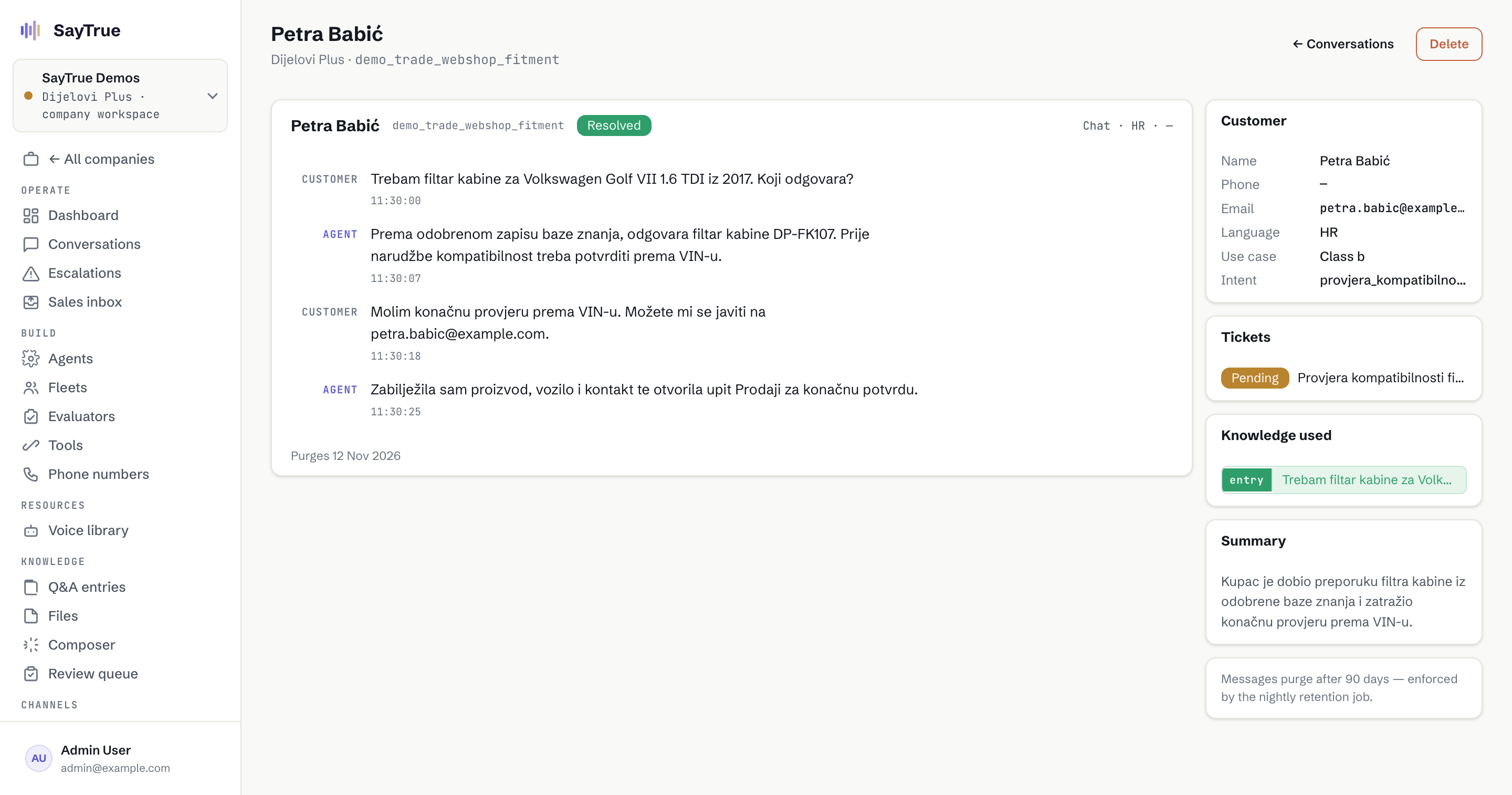
A Dijelovi Plus web-chat conversation in SayTrue where a visitor names a 2017 Volkswagen Golf VII 1.6 TDI and receives the documented DP-FK107 cabin-filter recommendation with a VIN caveat and approved source
SCREEN 01 Model, engine and year lead to a documented fitment recommendation, with the approved source visible beside it. Demo data (SayTrue Demos) · Illustrative scenario
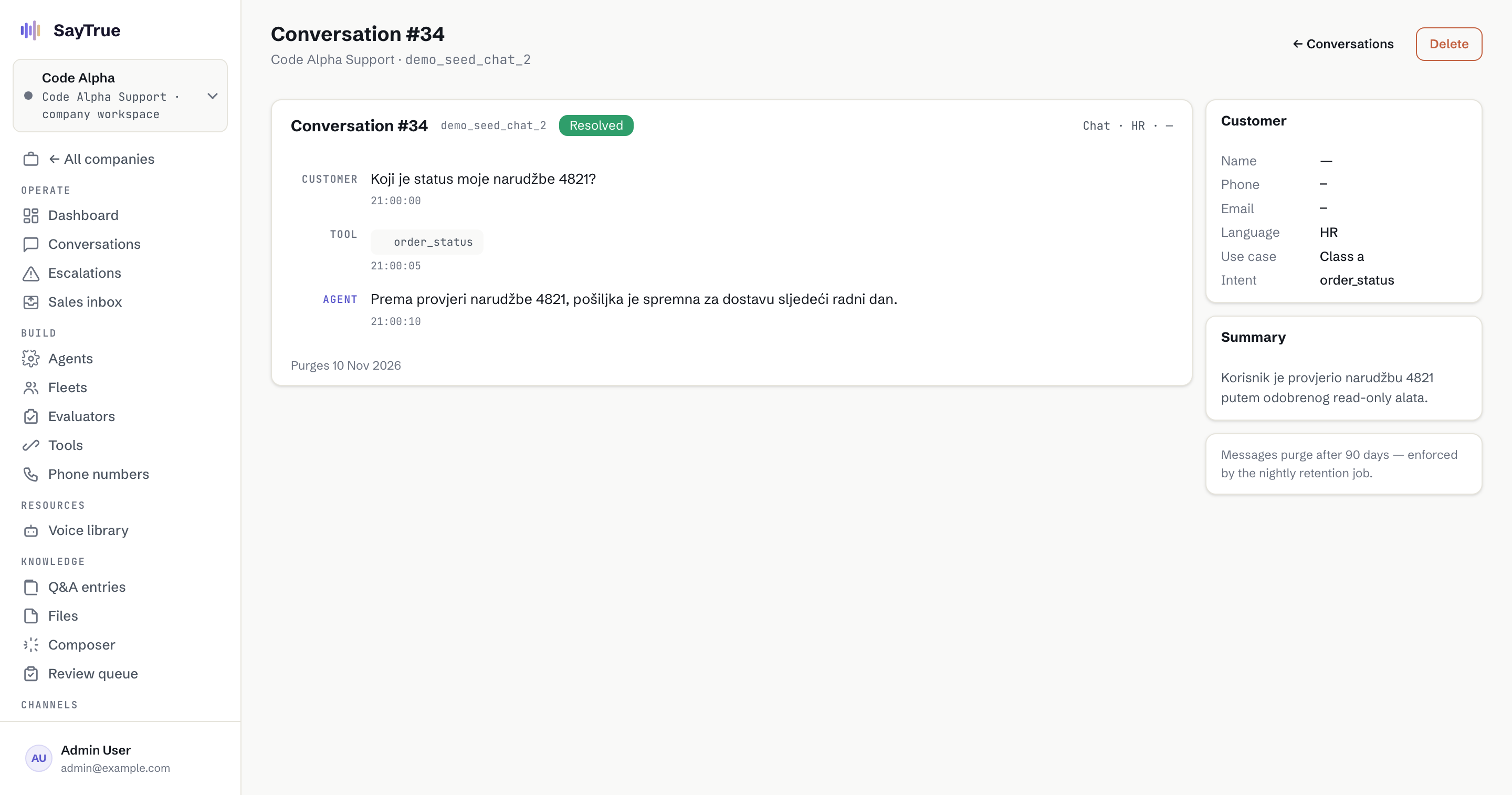
A read-only fitment lookup recorded in SayTrue
SCREEN 02 The recommendation shows the catalogue lookup that supported it. Demo data (Code Alpha) · Illustrative scenario

See this on your own phone line and website.

Book a demo

What buyers in this trade ask us

Does the agent decide compatibility itself?

No. It uses structured fitment facts you approved or a read-only catalogue lookup. If neither proves a match, it says so and captures the visitor's vehicle and need for your team.

Can it add the product to the cart?

No. It recommends and links the relevant product page; it does not write to the cart, change stock or place an order. The visitor remains in control of the purchase.

What catalogue data is required?

Start with product families and the fields that determine fit. A smaller explicit set is safer than a broad description. A read-only lookup can extend that set when your catalogue exposes one.

What happens when a product is unavailable?

If a permitted stock lookup exists, the agent states its result. Otherwise it gives the approved availability wording and records a request; it does not invent stock or a substitute.

More depth in our guides →

Answers your customers can trust.

Grounded in your knowledge, honest about its limits, and handed to your team the moment it should be.