Solutions

Breakdowns don't check your office hours first.

Property managers, utilities, service teams — every report taken whole, triaged by your urgency rules, delivered as a ticket your dispatcher can act on.

Complete intake

What broke, where, since when, how to get in

The agent asks for what your technicians need and records it structured — location, description, access, contact — with a timestamp.

Urgency rules

Your categories decide the path

Water, gas, elevator — the classifications you define route to your emergency arrangement; the rest queues honestly for business hours.

Protocol verbatim

Emergency instructions as YOU wrote them

On-call numbers and first-response steps are approved entries, stated exactly — never an improvised judgment call.

Morning order

A worked queue instead of a voicemail box

Night reports wait sorted and complete; your first coffee comes with a list, not a backlog of callbacks.

The story

The fault arrived with the details needed to route it.

A support team received messages such as 'it is broken' through several channels. The first person to read them still had to ask where, what changed, whether anyone was at risk and how to reach the reporter. Urgent issues and routine repairs looked identical in the queue.

The agent now follows the organisation's fault categories, asks the required questions and states only approved immediate instructions. Routine reports become tickets; categories marked urgent follow the working-hours and handover rules. The transcript keeps the reporter's exact description attached to the route.

The receiving team sees location, impact, access and contact before opening the request. It can change a category or escalation rule without rewriting the whole experience, test the path with a realistic call, and inspect unanswered cases rather than letting the agent fill gaps on its own.
How to structure fault reporting

  1. Define fault categoriesEach category names the location, identifiers, symptoms and safety details the team requires.
  2. Write immediate instructionsOnly approved steps such as isolating an area or contacting emergency services may be stated.
  3. Map urgency to a routeRoutine faults open tickets; configured urgent categories may transfer to an on-call team.
  4. Test missing informationReport a fault without a location and verify the agent completes the record before routing.

Every category carries its questions, approved instruction and route.

Question The agent answers Autonomy
The hallway light is out. Collects the building and exact location as a routine repair request. opens a ticket
There is water near an electrical panel. States the approved safety instruction and follows the urgent route. hands to a human
The app shows an error code. Records the account, device and exact code for technical support. opens a ticket
When will someone come? States only the response policy in the approved entry, not an invented arrival time. answers alone
I already reported this fault. Captures the reference and routes the follow-up to the responsible team. hands to a human
EXAMPLE KB Demo data (Code Alpha) · Illustrative scenario
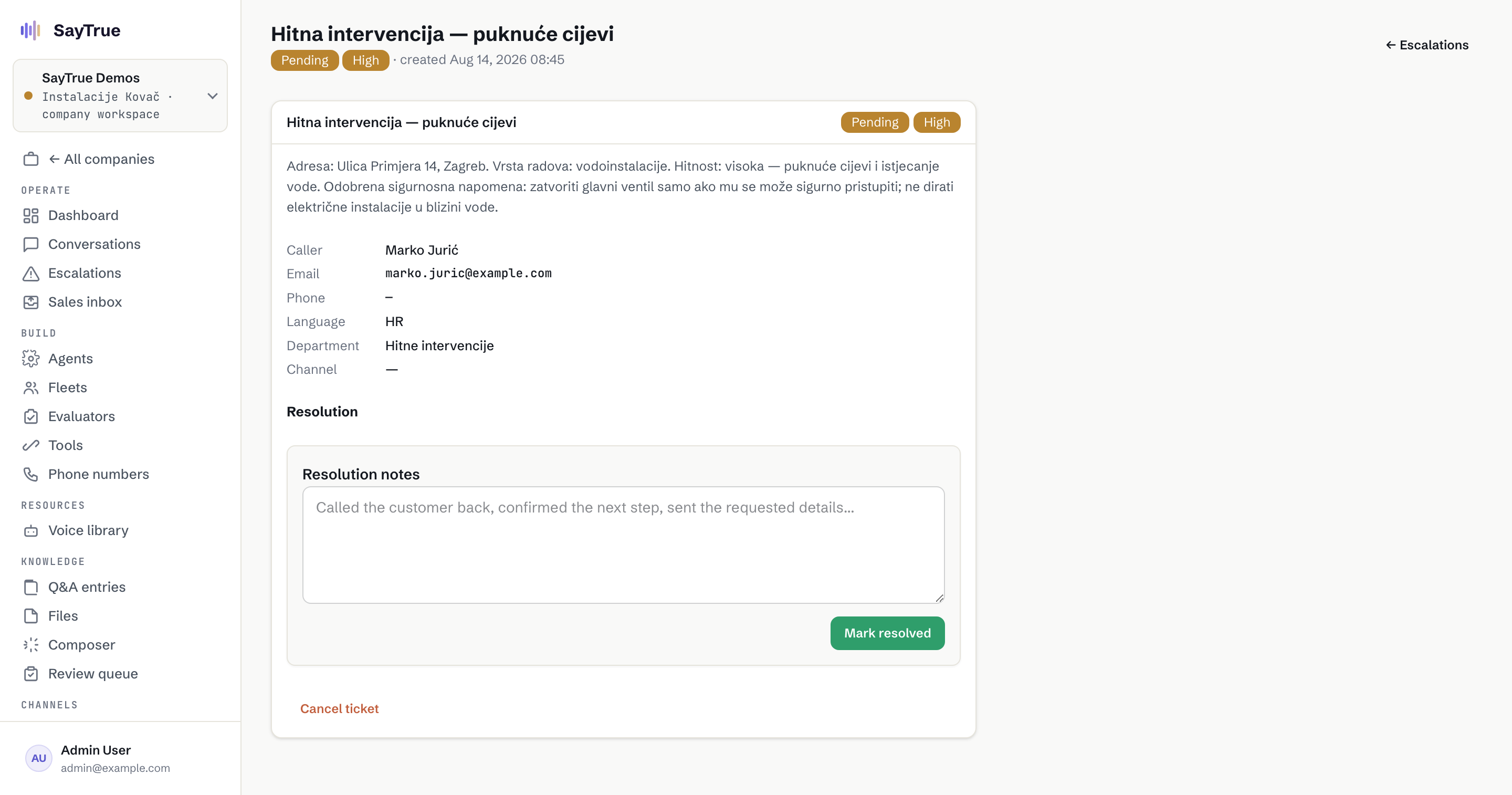
An Instalacije Kovač fault ticket in the SayTrue console showing Ulica Primjera 14, plumbing work, high priority, the approved safety note and the Hitne intervencije department
SCREEN 01 Address, plumbing fault, high priority and the approved safety note reach Emergency Interventions together. Demo data (SayTrue Demos) · Illustrative scenario
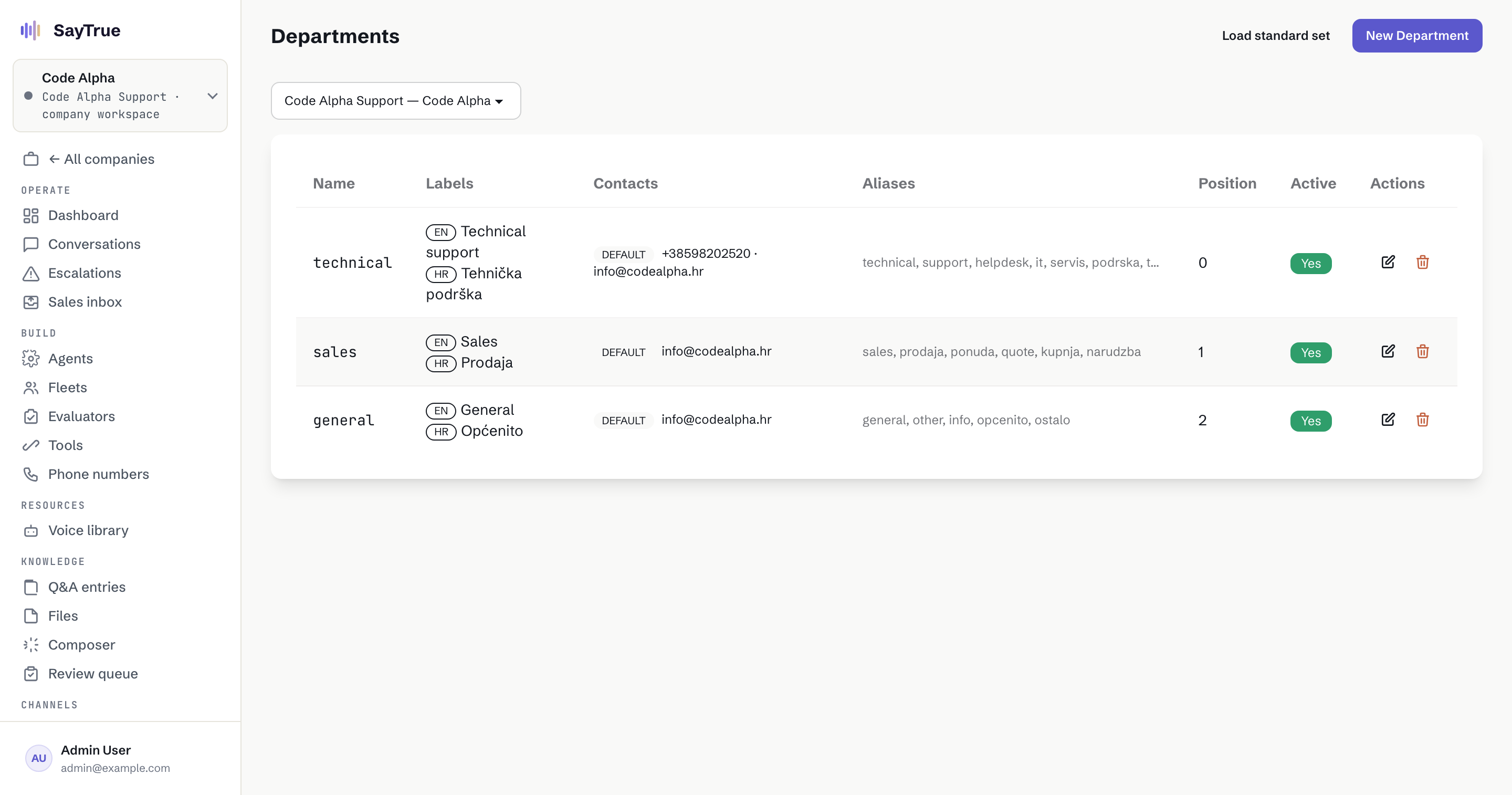
Fault categories routed to responsible departments
SCREEN 02 The route is configured before the report arrives. Demo data (Code Alpha) · Illustrative scenario

See this on your own phone line and website.

Book a demo

What buyers in this trade ask us

How does triage actually decide?

By matching the report against categories you defined — with ambiguity defaulting to the more cautious path you chose. The agent applies your rules; it does not invent severity judgments, and the transcript shows exactly what was reported and classified.

Can the reporter check what happened with their report?

If you expose work-order status read-only, the agent answers live with the lookup logged. Otherwise it records the follow-up request and states when your office responds — no invented progress updates.

What reaches our dispatcher?

A structured ticket: location, unit, reporter contact, description, urgency class, timestamp, plus the conversation itself. Dispatch starts with facts, and the source log answers any later dispute about what was said.

More depth in our guides →

Answers your customers can trust.

Grounded in your knowledge, honest about its limits, and handed to your team the moment it should be.