Solutions

The most expensive call is the one nobody answered.

Evening inquiries, season overflow, campaign spikes — the agent answers, records who wanted what with their contact, and your team follows up while the interest is warm.

Intent + contact

What they wanted, how to reach them

Every unresolved inquiry ends with a captured contact and a clear description of the need — the minimum a follow-up requires.

Overflow net

Busy lines stop meaning lost business

When your people are saturated, the agent holds the conversation, answers what it can, and records the rest structured.

Context attached

The whole conversation travels with the lead

Your follow-up call starts informed — what was asked, what was answered, where it stopped — from the transcript.

Your pipeline, your rules

Leads land where you work

In the console and at the addresses you configure — reviewed and worked by your team, in your process.

The story

The evening inquiry arrived ready for a useful follow-up.

A prospective customer reached a business after the sales line closed. The site had a contact form, but the visitor wanted to explain the need and ask a few questions first. A bare email address gave the morning team no reason, timing or product context.

SayTrue answers approved qualification questions, asks only for the fields the sales team needs, and creates a structured lead with the transcript. If the request requires advice or a commercial exception, it moves to a person. The agent does not quote terms that have not been approved.

The morning sales team sees the need, timing, contact and questions already together. It can prioritise a real opportunity without guessing what a form submission meant, while the visitor receives a truthful next step. Unapproved pricing and commitments remain with the person who owns them.
How to capture a useful lead

  1. Define a qualified inquiryChoose the need, location, timing, scale and contact fields that make follow-up actionable.
  2. Approve the early answersCoverage, service shape and process questions may be answered before a salesperson joins.
  3. Choose the sales destinationTickets and notifications reach the correct team with the conversation attached.
  4. Test a poor-fit requestConfirm the agent states the boundary honestly instead of forcing every caller into a lead.

Qualification entries answer the basics while preserving commercial judgment.

Question The agent answers Autonomy
Do you serve companies in my region? States the approved coverage area. answers alone
What information do you need for a proposal? Lists the approved discovery fields. answers alone
We want to discuss a rollout. Captures need, timing, scale and contact for sales. opens a ticket
Can you promise a custom discount? Does not invent commercial terms and hands the request to sales. hands to a human
Your service does not cover our required channel. States the current limitation and records the request only if follow-up is useful. opens a ticket
EXAMPLE KB Demo data (Code Alpha) · Illustrative scenario
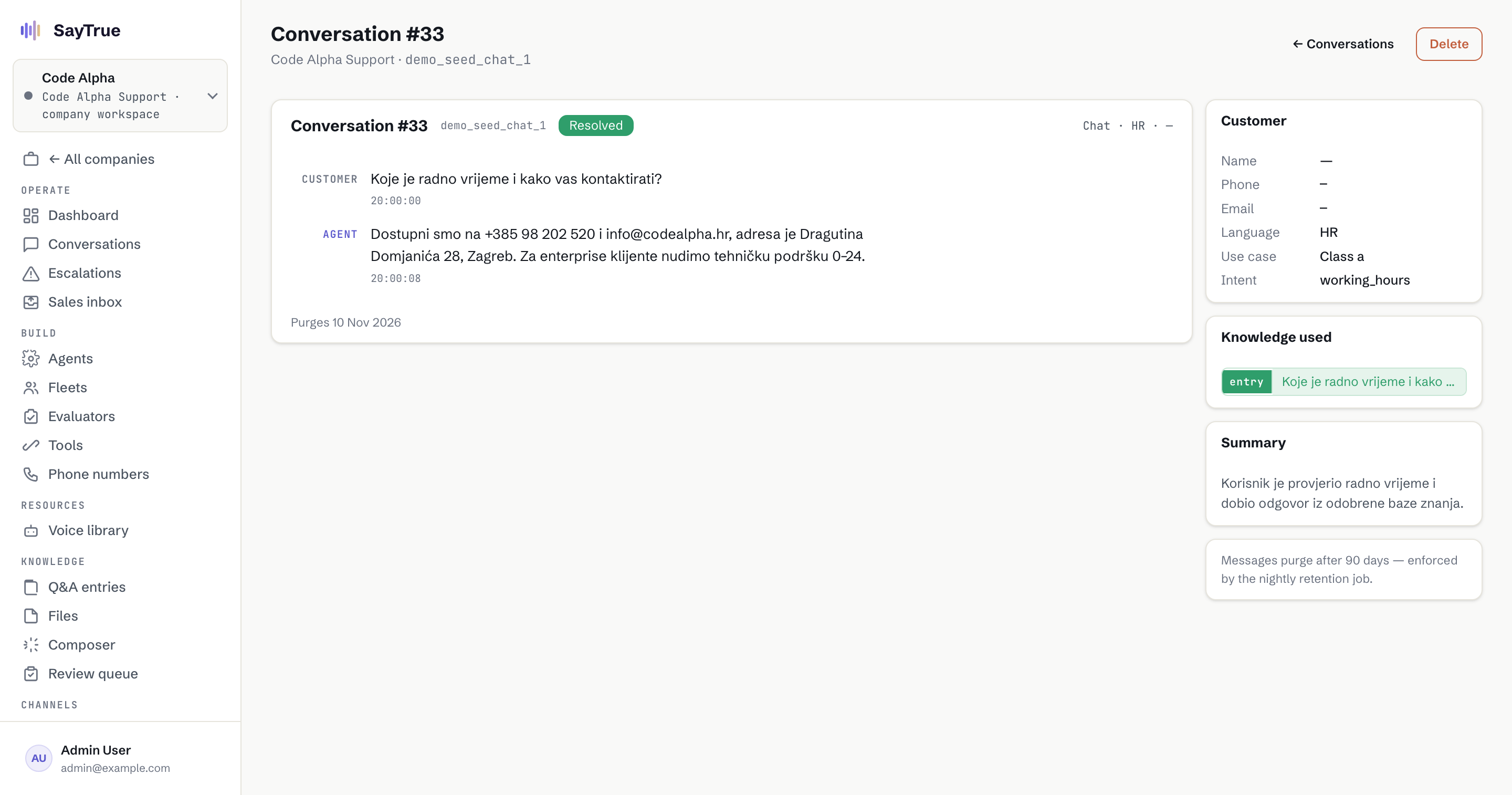
A qualified sales conversation in the SayTrue console
SCREEN 01 Need, timing and contact stay attached to the visitor's own words. Demo data (Code Alpha) · Illustrative scenario
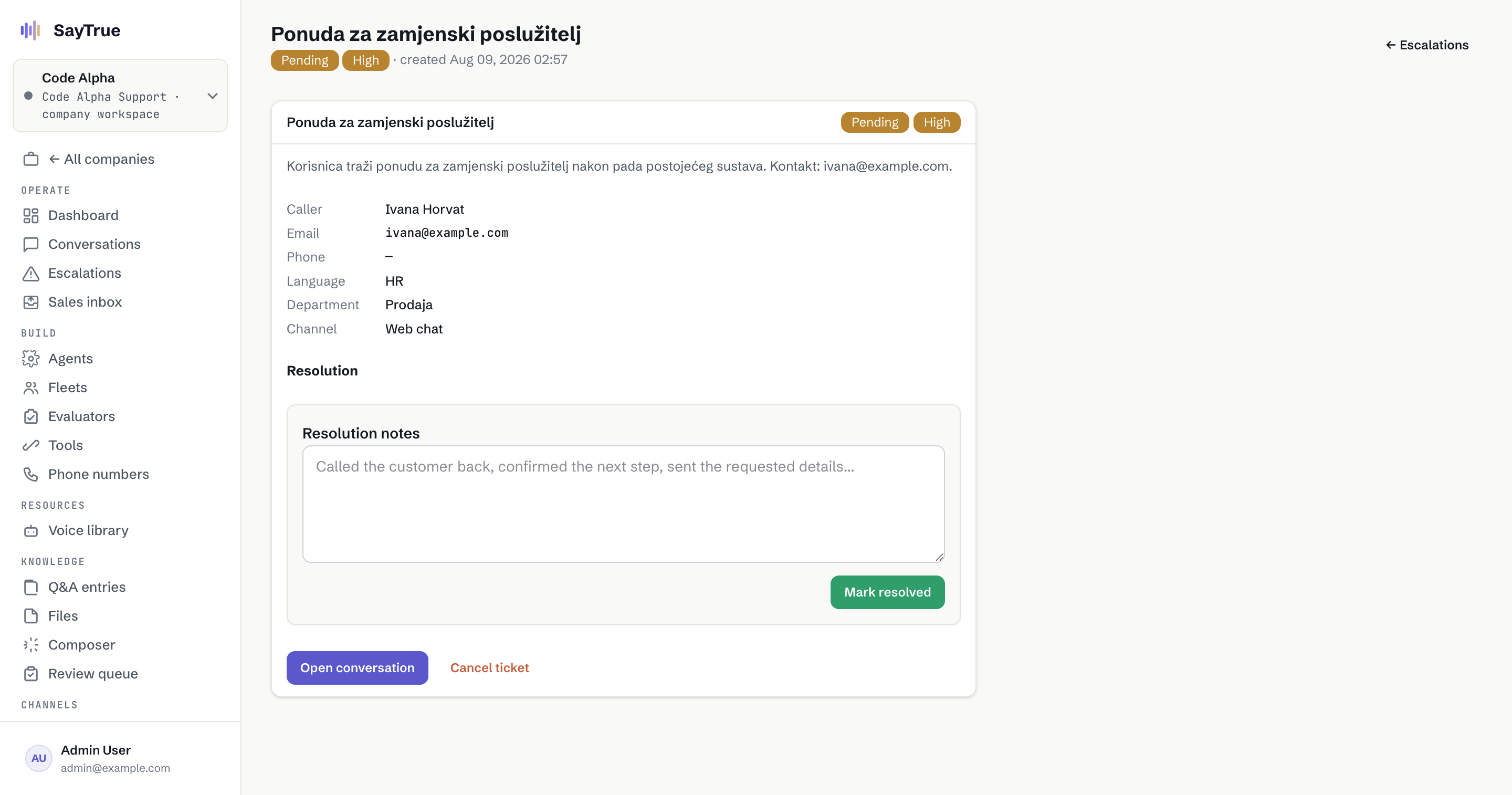
A handover ticket in the SayTrue console with the requester's name, email and phone and a link to the source conversation
SCREEN 02 The handoff arrives with name, email and phone, and the conversation attached — not a blank callback note. Demo data (Code Alpha) · Illustrative scenario

See this on your own phone line and website.

Book a demo

What buyers in this trade ask us

Is this a CRM?

No — it's the intake in front of one. Leads are structured records with conversation context; where they go next is your process. What the agent guarantees is the top of the funnel: no inquiry evaporates because of an hour or a busy line.

Does it qualify leads?

It captures what the caller said — need, timing, contact — faithfully. Scoring and prioritizing stay with your team; an agent that inflates a casual question into a 'hot lead' would be inventing, and inventing is what it's built to refuse.

How is this different from a contact form?

A form is silent until submitted; the agent answers questions first — hours, prices, availability basics — and captures the contact within a conversation that already delivered value. The caller got something; you got the lead.

More depth in our guides →

Answers your customers can trust.

Grounded in your knowledge, honest about its limits, and handed to your team the moment it should be.